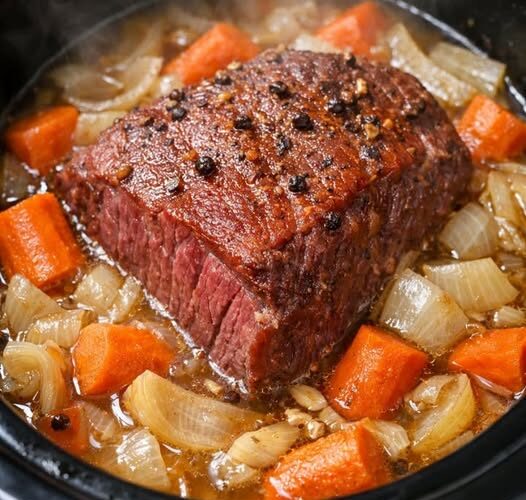
Slow Cooker Ginger Ale Corned Beef
Corned beef brisket cooked in ginger ale is the kind of recipe that raises a skeptical eyebrow right until the first bite — and then doesn’t raise it again. The idea of braising cured beef in soda seems like a novelty, but the result is entirely serious: ginger ale’s mild sweetness rounds out the saltiness of the brine, the carbonation works with the brisket’s tough connective tissue during the long, slow cook, and the subtle ginger character of the liquid gives the cooking juices a warmth and depth that plain water or even plain broth simply doesn’t produce. After eight to ten hours on LOW, the brisket is as tender as properly made corned beef should be — sliceable with almost no pressure, fully flavorful throughout — and the cooking liquid is a golden, fragrant broth worth ladling generously over everything on the plate.
Corned beef brisket already comes packaged with a spice packet that provides the classic corned beef seasoning — a blend typically including mustard seeds, peppercorns, coriander, bay leaves, and other whole spices. The four-ingredient approach here is elegant in its simplicity: the spice packet does the seasoning work so nothing additional is needed, the vegetables provide the aromatic support and a ready-made side dish, and the ginger ale does the braising work that water or broth would do in a conventional recipe but with more flavor and better results on the texture front.
Why Ginger Ale Works as a Braising Liquid
Ginger ale brings three properties to this application that plain water lacks. The first is mild sweetness from its sugar content — this sweetness counterbalances the brisket’s saltiness from the curing process and prevents the finished cooking liquid from tasting sharp and one-dimensionally briny. The second is carbonation — the dissolved carbon dioxide in the ginger ale creates a slightly acidic braising environment that helps break down the brisket’s collagen and tough connective tissue during the long, gentle cook, contributing to the characteristically tender, pull-apart texture of the finished meat. The third is the ginger flavoring — though subtle after eight to ten hours of cooking, the ginger’s warm, slightly spicy aromatic quality adds a pleasant background note to the finished broth that complements the spice packet’s peppercorns and coriander without competing with them.
The carbonation largely dissipates during the first hour of cooking as the slow cooker heats and the gas escapes from the liquid. What remains is the sweetened, ginger-flavored liquid that continues to do its braising work throughout the cook, infusing the brisket with its mild sweetness while concentrating and deepening as the cooking progresses. The resulting broth by the end of the cook is considerably more complex and flavorful than the ginger ale you started with — the brisket’s juices, the spice packet’s aromatics, and the vegetable’s released sweetness have all joined what was originally a simple carbonated beverage.
About Corned Beef Brisket
Corned beef is beef brisket that has been cured in a brine of salt and spices — the “corn” in the name refers to the large grains of rock salt (called “corns” of salt) historically used in the curing process, not to the grain corn. The curing process seasons the meat deeply throughout and begins the breakdown of the tough brisket’s dense muscle structure, but the meat still requires the long, slow, moist cooking of a braise to fully tenderize the remaining connective tissue into gelatin and make the beef genuinely fork-tender. Rushing the cooking process — using higher heat or shorter time — produces brisket that’s cooked through but still tough and chewy at the connective tissue level. The slow cooker on LOW for 8 to 10 hours is one of the most reliable methods available for consistently tender corned beef.
Corned beef brisket comes in two cuts: the flat cut (leaner, more uniform in shape, easier to slice neatly) and the point cut (fattier, more irregular in shape, more richly flavored but harder to slice uniformly). The flat cut is what most supermarkets stock as standard and is appropriate for this recipe. The point cut produces a more richly flavored result if you can source it.
Why You’ll Love This Recipe
Slow cooker corned beef is the most hands-off, reliably excellent method for producing a proper corned beef dinner. Unlike stovetop versions that require monitoring the simmer level and checking the water level throughout the day, the slow cooker simply needs to be set and left alone. The ginger ale addition is the recipe’s distinctive touch — it genuinely improves the finished result over plain water while requiring the same amount of effort, which is to say none. For St. Patrick’s Day or any occasion where corned beef is appropriate, this version is worth making as the standard.
Ingredient Notes
Corned beef brisket with spice packet — 3 to 3½ pounds — is the centerpiece. The spice packet that comes with the brisket is an important component: it contains the specific combination of whole spices that give traditional corned beef its distinctive flavor, and using it is central to the recipe. Rinse the brisket briefly under cold water before cooking — this removes some of the surface brine, which can be very concentrated and salty; it doesn’t significantly affect the seasoning of the meat itself, which is brined throughout. Pat dry after rinsing. If your brisket is exceptionally large (over 4 pounds), it may need to go closer to the 10-hour mark, and you may need a 7-quart slow cooker to accommodate it while also leaving room for the vegetables.
Yellow onion — one large, peeled and thickly sliced — forms part of the vegetable bed that the brisket rests on and contributes aromatic sweetness to the broth throughout the cook. Thick slices rather than thin ones are appropriate because the onion needs to maintain its structure through 8 to 10 hours in the slow cooker — thin slices dissolve completely into the broth, which is fine for flavor but means you won’t have distinct onion pieces as part of the finished plate.
Carrots — four medium, peeled and cut into 1½-inch chunks — provide the primary vegetable side dish and contribute their natural sweetness to the broth. Cut thick enough (1½ inches) to hold their shape through the long cook without dissolving. Carrots placed under or alongside the brisket at the beginning of the cook need all 8 to 10 hours on LOW to become properly tender — they’re denser than most vegetables and need the full cooking time. If you prefer very firm carrots, you can add them in the final 2 to 3 hours of the cook rather than at the start.
Ginger ale — approximately 4 cups, enough to come most of the way up the sides of the brisket — is the braising liquid. Use full-sugar ginger ale rather than diet — the sugar is part of what balances the brisket’s saltiness and contributes to the final broth’s character. Canada Dry is the most commonly available brand; any full-sugar ginger ale works. The ginger ale should not fully submerge the brisket — you want the top portion of the meat exposed to the steam environment inside the slow cooker rather than fully submerged in liquid, which allows the top to develop slightly more concentrated flavor than the submerged portion. Four cups is approximately right for a 5- to 6-quart slow cooker; a larger insert may require slightly more.
Ingredients
- 3 to 3½ lb corned beef brisket, with spice packet
- 1 large yellow onion, peeled and thickly sliced
- 4 medium carrots, peeled and cut into 1½-inch chunks
- 4 cups full-sugar ginger ale (approximately — enough to nearly cover the brisket)
Step-by-Step Instructions
Step 1 — Build the Vegetable Base
Spread the thickly sliced onion in an even layer across the bottom of a large (5- to 7-quart) slow cooker insert. Scatter the carrot chunks over the onion layer. The vegetables serve two purposes: they create an aromatic, flavorful base for the brisket that keeps the meat slightly elevated from direct contact with the bottom of the insert, and they become a side dish in their own right by the time the cook is complete, fully infused with the ginger ale, spice, and beef flavors of the cooking liquid.
Step 2 — Prepare and Position the Brisket
Remove the corned beef brisket from its packaging and rinse briefly under cold running water to remove excess surface brine. Pat completely dry with paper towels — removing surface moisture allows the spice packet’s flavors to adhere better to the meat surface. Place the brisket fat side up on top of the vegetable bed, positioning it so it fits comfortably in the insert. Fat side up is the correct orientation — the fat cap renders and bastes the meat as it melts during the long cook, keeping the upper surface of the brisket moist and adding richness to the cooking liquid below. Sprinkle the contents of the spice packet evenly over the top of the brisket, pressing lightly so the spices adhere to the surface rather than sliding off when the liquid is added.
Step 3 — Add the Ginger Ale
Pour the ginger ale carefully around the sides of the brisket into the slow cooker insert — direct it toward the edges of the insert rather than pouring it over the top of the spice-coated brisket, which would rinse the spices off the surface into the liquid prematurely. Add enough ginger ale to come most of the way up the sides of the brisket — roughly to the level where about an inch of the top of the meat is still above the liquid line. This partial submersion is intentional.
Step 4 — Cook
Cover the slow cooker and cook on LOW for 8 to 10 hours. The brisket is done when a fork slides in and out of the thickest part of the meat with virtually no resistance — it should feel like pushing a fork into butter. Do not open the lid during the first 6 hours of cooking. Each lid opening releases significant heat and steam, extending the cooking time by 15 to 30 minutes and disrupting the consistently humid environment that produces the most evenly tender result. Check at 8 hours and continue until the fork test is passed.
Step 5 — Rest the Brisket
Carefully transfer the cooked brisket to a cutting board using tongs or two large spatulas — it will be very tender and may want to fall apart, particularly at the edges. Tent loosely with aluminum foil and allow to rest for 10 minutes. This resting period allows the juices to redistribute throughout the meat, producing more evenly moist slices than cutting immediately would yield.
Step 6 — Plate the Vegetables and Finish the Broth
While the brisket rests, use a slotted spoon to carefully transfer the carrots and onions from the cooking liquid to a serving dish. Ladle some of the warm cooking broth over them to keep them moist and glossy. Skim excess fat from the surface of the remaining cooking liquid with a large spoon. Taste the broth — it should be savory, slightly sweet, and lightly spiced. This cooking liquid is good enough to ladle over the sliced brisket and alongside the vegetables at the table.
Step 7 — Slice and Serve
Slice the rested corned beef against the grain — look for the direction the muscle fibers run and cut perpendicular to them. Slicing with the grain produces long, chewy, stringy pieces; slicing against it produces tender, clean slices that hold together nicely on the plate. Slice to a thickness of ¼ to ½ inch. Arrange the slices on a serving platter alongside the carrots and onions, and spoon a generous amount of the cooking broth over everything just before bringing to the table to keep the meat moist and glistening.
Tips for the Best Results
Rinse the brisket before cooking. Packaged corned beef brisket is packed in its curing brine, which is very concentrated and salty. A brief rinse under cold water removes some of the surface brine without significantly affecting the seasoning that’s already been absorbed into the meat. This prevents the cooking liquid from becoming uncomfortably salty, which can happen when an unrinsed brisket braises in a relatively small volume of liquid.
Fat side up throughout the cook. The fat cap on top of a corned beef brisket continuously bastes the meat beneath it as it renders during the cook, keeping the upper surface moist and contributing rendered fat to the cooking liquid. Flipping the brisket fat side down removes this self-basting effect and can produce a drier upper surface.
Don’t skip the 10-minute rest. A well-browned surface retains its juices under pressure — a thoroughly cooked brisket has substantial juice content that rushes toward the cut surface when sliced. Ten minutes of resting allows the internal juices to redistribute and stabilize, producing more evenly moist slices throughout the whole brisket rather than juicy edges and a drier center.
Always slice against the grain. Corned beef brisket has a very pronounced grain direction. Slicing with the grain produces tough, chewy bites; slicing against it, even from the same very tender piece of meat, produces dramatically more tender, cleanly separating slices. Identify the grain direction before making the first cut and maintain it throughout.
Use the cooking liquid. The broth that remains in the slow cooker after the brisket is removed is one of the best parts of the dish. Ladle it over the sliced meat on the serving platter, spoon it over the vegetables, and set it on the table in a small pitcher for guests to add to their plates. Served this way, it keeps the meat moist through the meal and contributes meaningfully to the overall flavor of every bite.
Frequently Asked Questions
Can I add cabbage to this recipe?
Yes — and it’s the most natural and traditional addition. Add quartered cabbage wedges (leave the core intact to keep the wedges together) to the slow cooker in the final 2 to 3 hours of cooking, nestling them around and slightly submerged in the cooking liquid. Cabbage added at the beginning of the cook will be very soft and somewhat mushy after 8 to 10 hours; adding it in the final stretch preserves more of its texture. This produces the complete corned beef and cabbage dinner in a single pot.
Can I add potatoes?
Yes. Medium Yukon Gold or red potatoes added whole or halved to the slow cooker at the beginning of the cook will be fully tender after 8 to 10 hours on LOW, having absorbed the ginger ale, spice, and beef flavors of the cooking liquid. Large russet potatoes may not cook evenly in this time — cut them into large chunks for more reliable results. Adding potatoes makes the single pot a complete traditional corned beef dinner (meat, cabbage added late, potatoes, and carrots) without any additional preparation.
What can I do with the leftover cooking liquid?
The cooking liquid is a golden, lightly spiced, slightly sweet and savory broth that’s excellent in several applications. Refrigerate it overnight — the fat will solidify on the surface and can be removed cleanly. The skimmed broth makes an excellent base for a split pea soup or a lentil soup, contributes flavor to braised cabbage on the stovetop, and can be used in place of water when cooking rice or barley for a side dish. It can also be reduced on the stovetop by simmering uncovered until it thickens to a sauce consistency, which makes a flavorful drizzle for the next day’s corned beef hash.
Can I make this ahead?
Yes. Cook the corned beef completely, allow it to cool in the cooking liquid, and refrigerate overnight (or up to 3 days) in the liquid. The brisket becomes even more evenly moist overnight as the juices redistribute further. Reheat by slicing the cold brisket and warming the slices in a covered skillet with a ladle of the cooking liquid over medium-low heat, or by returning the whole unsliced brisket to the slow cooker with the cooking liquid and reheating on LOW for 1 to 2 hours.
Can I broil the finished brisket for a crisper exterior?
Yes — and it’s an excellent optional finish that adds textural interest and a slightly caramelized appearance. Transfer the rested, unsliced brisket to a foil-lined baking sheet. Brush the top surface with a small amount of the cooking liquid and place under the broiler set to HIGH for 3 to 5 minutes, watching closely, until the top surface is darkened and slightly crisped. Remove and slice immediately. The broiled surface provides a pleasant textural contrast to the tender interior and makes the finished platter look more impressive.
Variations Worth Trying
Ginger ale and beef broth version: Replace two cups of the ginger ale with two cups of low-sodium beef broth. This produces a less sweet, more savory braising liquid with the ginger character of the ale present but more balanced against the beef broth’s depth. Many people prefer this version if they find the full ginger ale version slightly too sweet. The broth also produces a richer-colored cooking liquid.
Classic corned beef and cabbage: Add a head of green cabbage cut into six to eight wedges (core intact to hold them together) in the final 2 to 3 hours of cooking. Add quartered medium Yukon Gold potatoes at the beginning of the cook alongside the carrots. The result is the complete traditional Irish-American St. Patrick’s Day dinner from a single slow cooker — meat, cabbage, potatoes, and carrots all cooked together in the same ginger ale broth.
Brown sugar and ginger ale version: Sprinkle two tablespoons of packed brown sugar over the spice packet on the surface of the brisket before adding the ginger ale. The brown sugar caramelizes into the cooking liquid during the cook, adding a deeper, more molasses-forward sweetness that gives the broth a richer, more complex character. This version is particularly good finished under the broiler, where the brown sugar creates a slightly caramelized crust on the top surface of the brisket.
Dijon and ginger ale version: Spread a tablespoon of Dijon mustard over the top of the brisket before sprinkling on the spice packet. The mustard adds a tangy, complex depth to the surface of the meat and contributes a subtle sharpness to the broth that cuts through the ginger ale’s sweetness. This is particularly good for people who prefer a less sweet, more savory-dominant braising liquid.
Stout and ginger ale version: Replace one cup of the ginger ale with one cup of Guinness or similar dark stout. The stout adds a roasted, slightly bitter depth that complements the corned beef’s seasoning beautifully and pushes the flavor profile in a more explicitly Irish direction. The finished broth is darker and richer than the straight ginger ale version, with a more complex flavor that’s particularly fitting for a St. Patrick’s Day celebration.
What to Serve Alongside
Traditional corned beef and cabbage aside (which incorporates the vegetables directly into the slow cooker), this version with just carrots and onions pairs naturally with buttery boiled potatoes, which absorb the cooking broth beautifully when the broth is ladled over them. Mashed potatoes are equally good — a ladle of the ginger ale cooking broth over buttery mashed potatoes is a combination worth trying. For a lighter accompaniment, steamed green beans or a simple green salad provide freshness and a bitter note that contrasts with the brisket’s rich saltiness. Irish soda bread is the most traditionally appropriate bread alongside, though any crusty bread for sopping up the cooking broth at the end of the plate is excellent. A pint of Guinness or a glass of cold apple cider alongside is a fitting beverage pairing for the occasion.
Leftover Uses
Corned beef makes exceptional leftovers in a range of applications. Thinly sliced cold corned beef between two slices of rye bread with Swiss cheese, sauerkraut, and Thousand Island dressing is a classic Reuben sandwich that’s worth making deliberately from leftover corned beef rather than treating as an afterthought. Corned beef hash — diced cold brisket pan-fried with diced potatoes and onion until crispy on the outside, topped with a fried egg — is one of the most satisfying breakfast or brunch dishes possible from leftovers. Diced corned beef stirred into a simple vegetable soup adds protein and depth. All of these applications are reasons to make a slightly larger brisket than you need for the initial dinner.
Storage
Cooked corned beef keeps in the refrigerator for up to 5 days, stored in an airtight container in the cooking liquid to prevent it from drying out. The meat slices most neatly when cold — if you plan to slice for sandwiches, slice while cold and reheat the slices gently in a covered pan with a spoonful of the cooking liquid. The whole unsliced brisket can be frozen for up to 2 months wrapped tightly in foil and then in a freezer bag; thaw overnight in the refrigerator before reheating.
A Simple Trick That Actually Works
Slow Cooker Ginger Ale Corned Beef is the kind of recipe that rewards the initial skepticism with a result good enough to become the new standard method. The ginger ale genuinely improves the finished dish — the sweetness that balances the brine, the carbonation that aids the connective tissue breakdown, the subtle ginger warmth in the finished broth — and it does so without requiring any additional effort beyond opening a can rather than a carton of broth. Four ingredients, eight to ten hours on LOW, and the most consistently tender corned beef the slow cooker can produce.